Billor CoPilot — Product Discovery for complex logistics operations
Reframing a driver-first trucking experience through research, operational workflows and scalable product patterns.
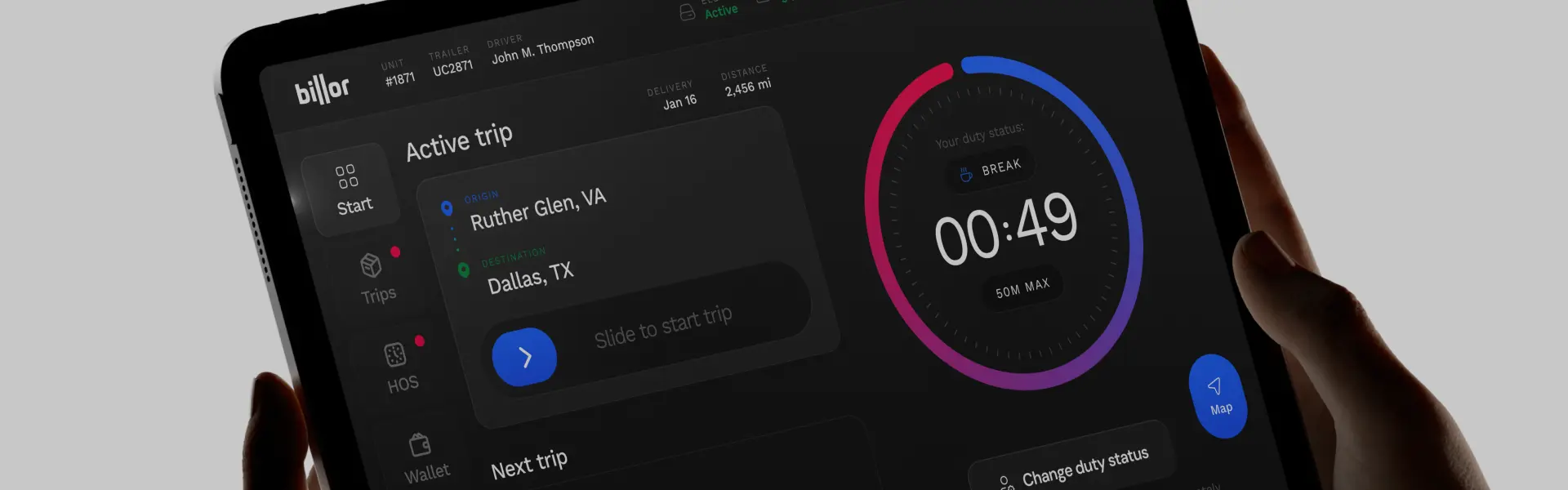
Client
Billor
My Contribution
- Product strategy
- User research
- Information architecture
- Visual design
- Prototyping
Timeline
2026
Team
- 1 Product Designer
- 4 Software Engineers
- 1 QA Analyst
The ELD market is commoditized. Samsara, Motive, and Omnitracs dominate by selling compliance and fleet management to dispatchers. None of them treat the driver as an entrepreneur partner — even though truck-as-a-service only works when drivers succeed.
CoPilot was built for Billor, a company that gives drivers access to trucks without ownership. Success depends on loyalty, education, crisis retention, and helping drivers earn more with less debt.
The challenge: build a platform that makes compliance feel like partnership — not surveillance.
Billor's drivers are 40–55, with limited formal education and low tech familiarity. They're skeptical of complex systems, afraid of mistakes that lead to penalties, and worried that any monitoring tool is there to punish — not help.
• Complexity kills adoption. A driver in a vibrating cabin, wearing gloves, managing cargo and documents, cannot navigate dense interfaces or multi-step flows.
• Trust is fragile. Drivers feel replaceable, monitored, and disconnected from the company and their families during long hauls.
• Value is unclear. Existing tools show compliance status but hide the connection between daily actions and real earnings.
I mapped what I knew, what I assumed, and what I still had to prove. Research combined demographic data, field observations in real cabins, and interviews with dispatchers and drivers across Billor's network.
Drivers want simplicity, real earnings, human support, recognition, and predictability.
Each pain point became a hypothesis I could test — connecting design decisions to expected outcomes across onboarding, daily use, support, and retention.
Drivers need simplicity, financial transparency, human support, and recognition. Safety and compliance are non-negotiable.
Premium onboarding creates loyalty. Gamification with real rewards increases retention. Proactive support reduces abandonment.
Can one platform hold ELD compliance, education, performance, finances, and support — without overwhelming drivers?
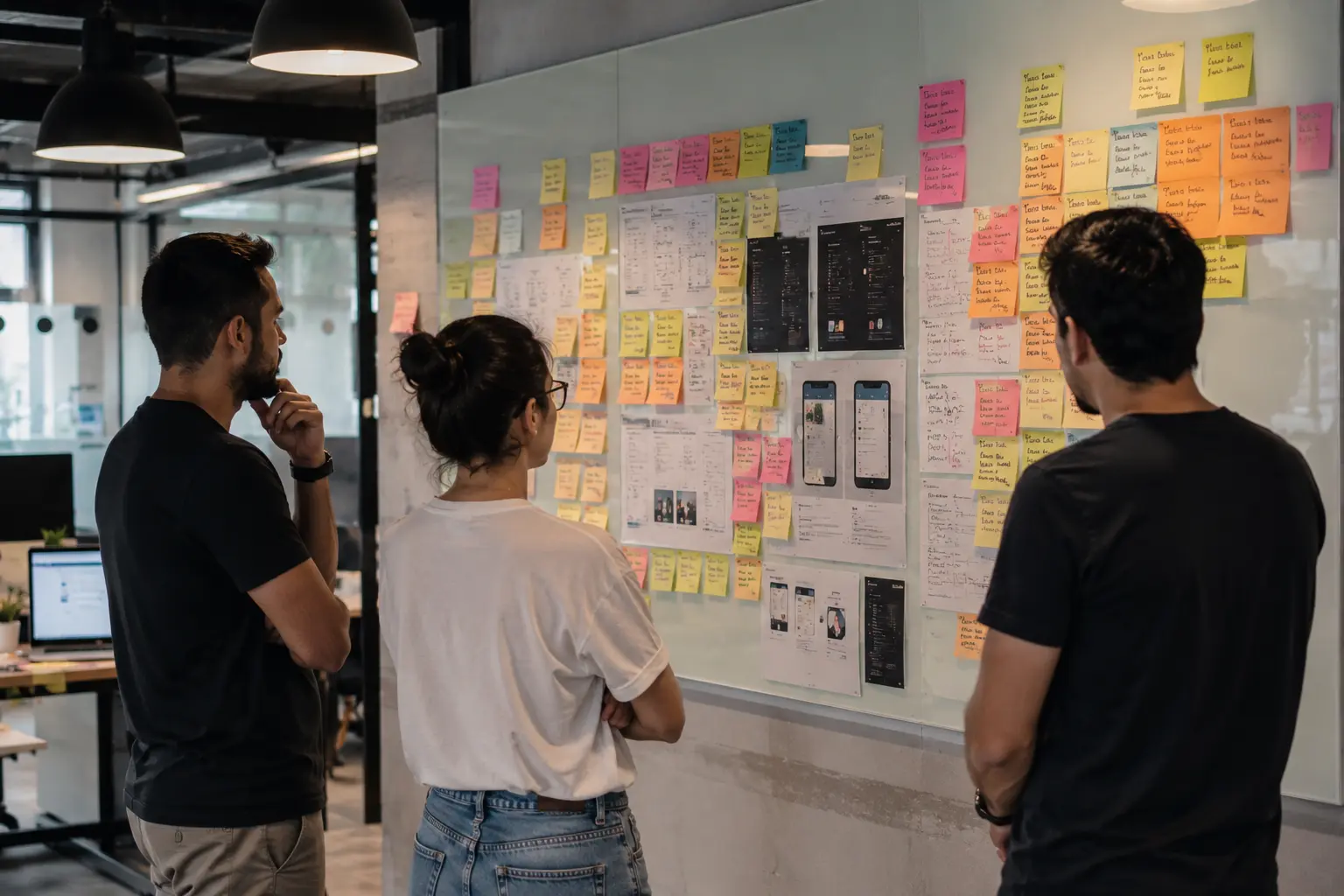
I audited Samsara, Motive, Omnitracs. Every platform optimized for fleet managers, not drivers. That gap defined every decision.
Four decisions defined what CoPilot would become — and what it refused to be.
| Decision | Rejected | Chosen | Why |
|---|---|---|---|
| Primary user | Fleet-first, dispatcher-centric design | Driver-first, owner-operator mindset | Truck-as-a-service succeeds only when drivers succeed |
| Feature density | Full ELD + marketplace + community at launch | Radical simplicity; max 3 taps for critical actions | Low digital literacy and extreme cabin context demand simplicity |
| Support model | AI-first chatbot hidden in menus | Human dispatcher visible + AI assistant as fallback | Trust is built with humans first, automation second — drivers in interviews feared systems, not people |
| Connectivity | Always-online dependency | Robust offline mode with silent sync | Intermittent connectivity cannot block compliance or earnings |
I structured the app around what drivers do daily. Each tab maps to a mental model: my day, my work, my hours, my money, my learning, my help.
| Area | Problem in Original IA | New IA Objective |
|---|---|---|
| WORK | No single place to start the day | "See My Day" — checklists, HOS, active load, next load, weekly earnings |
| LOADS | Load details scattered across screens | "Do My Work" — current, upcoming, and historical loads in one flow |
| HOS | Status changes buried in menus | "Log My Work" — 1-tap status, visible timer, audit history |
| WALLET | Earnings opaque and delayed | "See My Earnings" — gross, costs, net profit, progress bars |
| MORE | Learning and settings hard to find | "Learn & Adjust" — academy, assistant, profile, accessibility |
| SUPPORT | Help hidden in menus; panic moments unaddressed | Floating button — call, panic, assistant always one tap away |
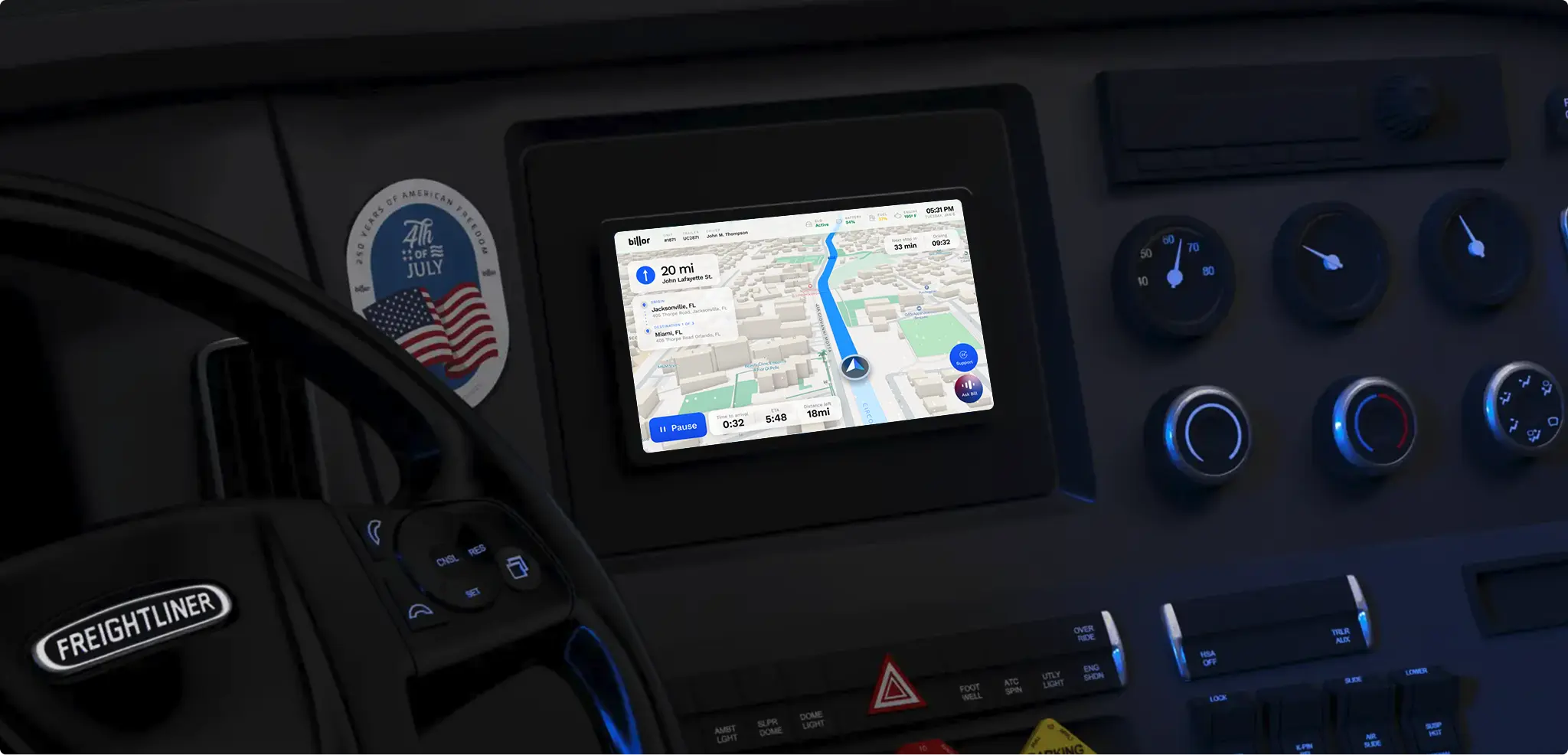
Four pillars emerged from the tensions — each turns a compliance burden into partnership.
• First Mile. Transform receiving a truck into a memorable ritual — welcome kit, pre-configured tablet, personal truck photo, CEO welcome video, and a 3-minute interactive tour.
• Entrepreneurship. Reinforce that drivers are business owners. Clear earnings, progress toward goals, and transparent costs help them make more money and manage debt.
• Daily Use. Convert compliance into capability. Truck-first navigation, proactive HOS widget, visible dispatcher, and voice commands keep drivers safe and efficient.
• Continuous Engagement. Micro-rewards, badges, weekly recaps, and a driverboard create a sense of progress and belonging without punitive pressure.
Three constraints shaped the product more than any feature list:
• Automation vs control. How much the system decides for the driver vs how much the driver holds.
• Breadth vs simplicity. How many features fit inside a cabin-safe, low-literacy interface.
• Human support vs scale. When a person must step in and when automation is enough.
• Claude. Synthesized 8+ hours of driver interviews into pain patterns and journey stages — weeks of analysis compressed into structured hypotheses.
• ChatGPT. Structured the app's IA — mapping driver mental models to navigation flows. Generated and tested UX copy across onboarding, financial dashboards, and low-literacy segments.
• Figma Make. Explored rapid ideation through AI-generated interface concepts — testing layout directions before committing to high-fidelity.
I owned product strategy and design for CoPilot from framing to handoff — the driver-first direction, the radical-simplicity scope, and the four-pillar product architecture were mine to define and defend against the pressure to build everything at once. There was no PM on this team: the engineers owned implementation, QA owned validation, and I carried the product point of view — including every "no" to stakeholder requests.
The MVP is ready for pilot. These targets were defined with the team for post-launch measurement. The measurement plan: first-attempt onboarding completion, error rate on first load, and daily engagement across the pilot cohort — reviewed weekly, with design iterating against the data before wider rollout. Beyond metrics, the shift is strategic: CoPilot positions Billor as the only truck-as-a-service company that treats drivers as partners from day one.
CoPilot taught me that designing for extreme contexts is subtraction. Every feature had to earn its place against a vibrating cabin, intermittent connectivity, and drivers who must trust before they use.
The hardest part was resisting the pressure to build everything at once. The value came from choosing a narrow promise and delivering it with clarity: I am on the driver's side.